




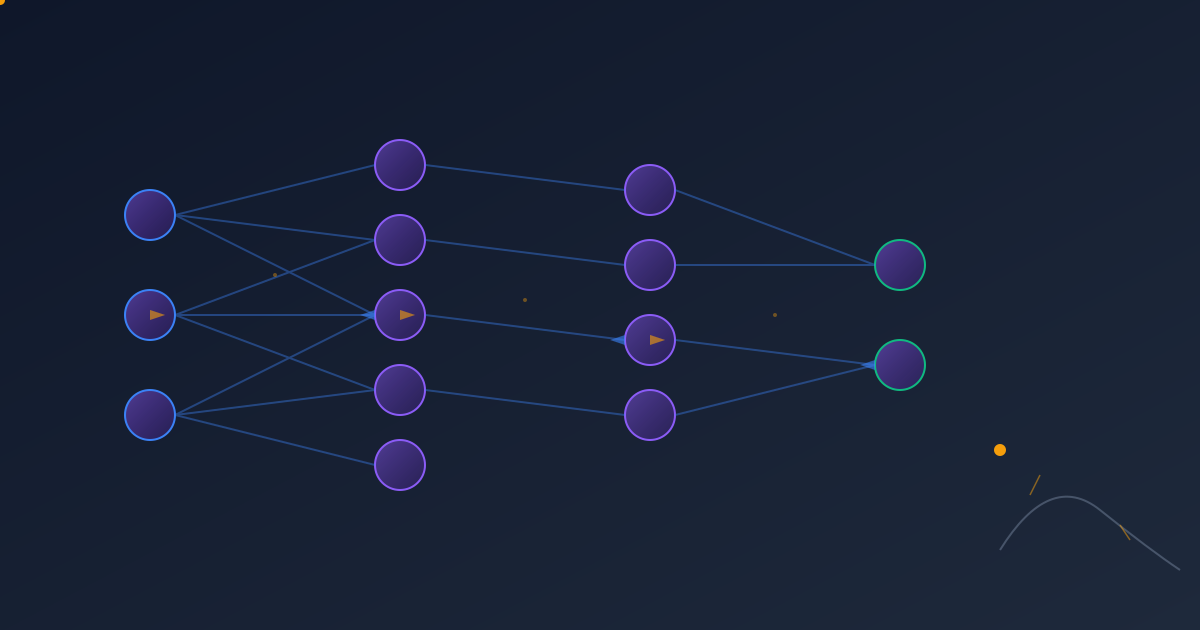
The Foundation of Deep Learning
Backpropagation is the workhorse algorithm behind modern deep learning. Despite its ubiquity, the mathematics underlying this elegant algorithm often remain mysterious. This post demystifies backpropagation by building up from first principles to practical implementation.
Whether you’re training a simple feedforward network or debugging a complex architecture, understanding how gradients flow backward through your network is essential for effective machine learning engineering.
The Problem: How Do Networks Learn?
At its core, training a neural network is an optimization problem. Given a dataset of inputs and expected outputs, we need to adjust millions of parameters to minimize prediction error.
The Challenge: Parameters are interconnected through layers of non-linear transformations. How do we compute the gradient of the loss function with respect to each individual weight?
The Solution: Backpropagation efficiently computes these gradients by applying the chain rule of calculus, propagating errors backward through the network.
Forward Pass: Setting the Stage
Before we can propagate errors backward, we need to understand the forward pass. Consider a simple neural network:
import numpy as np

class SimpleNeuralNetwork:
    def __init__(self, input_size, hidden_size, output_size):
        # Initialize weights with small random values
        self.W1 = np.random.randn(input_size, hidden_size) * 0.01
        self.b1 = np.zeros((1, hidden_size))

        self.W2 = np.random.randn(hidden_size, output_size) * 0.01
        self.b2 = np.zeros((1, output_size))

    def sigmoid(self, x):
        """Activation function"""
        return 1 / (1 + np.exp(-x))

    def forward(self, X):
        """Forward pass through the network"""
        # Hidden layer
        self.z1 = np.dot(X, self.W1) + self.b1
        self.a1 = self.sigmoid(self.z1)

        # Output layer
        self.z2 = np.dot(self.a1, self.W2) + self.b2
        self.a2 = self.sigmoid(self.z2)

        return self.a2
Key Insight: We store intermediate values (z1, a1, z2, a2) because we’ll need them during backpropagation.
The Chain Rule: The Key to Backpropagation
Backpropagation is fundamentally an application of the chain rule. For a composition of functions:
Loss = f(g(h(x)))The derivative with respect to x is:
dLoss/dx = (dLoss/df) × (df/dg) × (dg/dh) × (dh/dx)In neural networks, this becomes:
dLoss/dW = (dLoss/da) × (da/dz) × (dz/dW)Where:
ais the activation outputzis the pre-activation value (weighted sum)Wis the weight matrix
Backward Pass: Computing Gradients
Let’s implement the backward pass step by step:
def backward(self, X, y, learning_rate=0.01):
    """
    Backward pass through the network
    X: input data
    y: true labels
    """
    m = X.shape[0]  # number of examples

    # 1. Compute output layer gradients
    # Loss derivative with respect to output
    dLoss_da2 = self.a2 - y

    # Activation derivative (sigmoid: a * (1 - a))
    da2_dz2 = self.a2 * (1 - self.a2)

    # Combine using chain rule
    delta2 = dLoss_da2 * da2_dz2

    # Gradients for W2 and b2
    dW2 = np.dot(self.a1.T, delta2) / m
    db2 = np.sum(delta2, axis=0, keepdims=True) / m

    # 2. Compute hidden layer gradients
    # Propagate error backward to hidden layer
    dLoss_da1 = np.dot(delta2, self.W2.T)

    # Hidden layer activation derivative
    da1_dz1 = self.a1 * (1 - self.a1)

    # Combine using chain rule
    delta1 = dLoss_da1 * da1_dz1

    # Gradients for W1 and b1
    dW1 = np.dot(X.T, delta1) / m
    db1 = np.sum(delta1, axis=0, keepdims=True) / m

    # 3. Update parameters using gradient descent
    self.W2 -= learning_rate * dW2
    self.b2 -= learning_rate * db2
    self.W1 -= learning_rate * dW1
    self.b1 -= learning_rate * db1

    return dW1, db1, dW2, db2
Understanding the Gradient Flow
The magic happens in how errors propagate backward:
Layer 2 (Output Layer)
- Error at output:
delta2 = (prediction - actual) * sigmoid_derivative - Weight gradient: How much each hidden neuron contributed to the error
- Bias gradient: Average error across all examples
Layer 1 (Hidden Layer)
- Propagated error:
dLoss_da1 = delta2 × W2.T- Each hidden neuron receives error proportional to its outgoing weight strengths
- Local gradient: Multiply by activation derivative
- Weight gradient: How much each input contributed to the propagated error
Key Insight: Errors flow backward through the same connections that information flowed forward, weighted by those connection strengths.
Complete Training Loop
Putting it all together:
def train(network, X_train, y_train, epochs=1000, learning_rate=0.01):
    """
    Train the neural network
    """
    losses = []

    for epoch in range(epochs):
        # Forward pass
        predictions = network.forward(X_train)

        # Compute loss (Mean Squared Error)
        loss = np.mean((predictions - y_train) ** 2)
        losses.append(loss)

        # Backward pass
        network.backward(X_train, y_train, learning_rate)

        # Print progress
        if epoch % 100 == 0:
            print(f"Epoch {epoch}, Loss: {loss:.4f}")

    return losses

# Example usage: XOR problem
X = np.array([[0, 0], [0, 1], [1, 0], [1, 1]])
y = np.array([[0], [1], [1], [0]])

network = SimpleNeuralNetwork(input_size=2, hidden_size=4, output_size=1)
losses = train(network, X, y, epochs=5000, learning_rate=0.5)

# Test the trained network
predictions = network.forward(X)
print("\nFinal predictions:")
print(predictions.round(2))
Output:
Epoch 0, Loss: 0.2501
Epoch 100, Loss: 0.2496
Epoch 200, Loss: 0.2484
...
Epoch 4800, Loss: 0.0023
Epoch 4900, Loss: 0.0021

Final predictions:
[[0.02]
 [0.98]
 [0.98]
 [0.03]]
Common Pitfalls and Solutions
1. Vanishing Gradients
Problem: Sigmoid derivatives shrink gradients exponentially in deep networks.
Solution: Use ReLU or other activation functions with better gradient properties:
def relu(self, x):
    return np.maximum(0, x)

def relu_derivative(self, x):
    return (x > 0).astype(float)
2. Exploding Gradients
Problem: Gradients grow exponentially, causing unstable training.
Solutions:
- Gradient clipping:
gradients = np.clip(gradients, -threshold, threshold) - Proper weight initialization (He or Xavier initialization)
- Batch normalization
3. Numerical Stability
Problem: Computing exp() for sigmoid can overflow.
Solution: Use numerically stable implementations:
def stable_sigmoid(x):
    """Numerically stable sigmoid"""
    return np.where(
        x >= 0,
        1 / (1 + np.exp(-x)),
        np.exp(x) / (1 + np.exp(x))
    )
Vectorization: Making It Fast
The implementations above use vectorized operations. Here’s why that matters:
Naive Loop Implementation (Slow)
# Computing dW1 element by element - DO NOT DO THIS
dW1 = np.zeros_like(self.W1)
for i in range(X.shape[0]):  # for each example
    for j in range(self.W1.shape[0]):  # for each input feature
        for k in range(self.W1.shape[1]):  # for each hidden neuron
            dW1[j, k] += X[i, j] * delta1[i, k]
dW1 /= X.shape[0]
Vectorized Implementation (Fast)
# Single matrix multiplication
dW1 = np.dot(X.T, delta1) / X.shape[0]Performance: Vectorized code is typically 100-1000x faster due to:
- CPU SIMD instructions
- Optimized BLAS libraries
- Better cache utilization
- GPU parallelization (with appropriate libraries)
Automatic Differentiation: Modern Approach
While understanding manual backpropagation is crucial, modern frameworks handle this automatically:
import torch
import torch.nn as nn

class TorchNetwork(nn.Module):
    def __init__(self, input_size, hidden_size, output_size):
        super().__init__()
        self.layer1 = nn.Linear(input_size, hidden_size)
        self.layer2 = nn.Linear(hidden_size, output_size)
        self.activation = nn.Sigmoid()

    def forward(self, x):
        x = self.activation(self.layer1(x))
        x = self.activation(self.layer2(x))
        return x

# Training loop
model = TorchNetwork(2, 4, 1)
criterion = nn.MSELoss()
optimizer = torch.optim.SGD(model.parameters(), lr=0.5)

X_tensor = torch.FloatTensor(X)
y_tensor = torch.FloatTensor(y)

for epoch in range(5000):
    # Forward pass
    predictions = model(X_tensor)
    loss = criterion(predictions, y_tensor)

    # Backward pass - PyTorch computes gradients automatically!
    optimizer.zero_grad()  # Clear previous gradients
    loss.backward()        # Compute gradients via backpropagation
    optimizer.step()       # Update parameters
Key Advantage: PyTorch’s autograd automatically handles:
- Gradient computation for any architecture
- GPU acceleration
- Memory-efficient gradient computation
- Support for dynamic computation graphs
Computational Graph Perspective
Modern frameworks represent neural networks as computational graphs:
Input (X)
  ↓
[Linear: W1, b1]
  ↓
[Sigmoid]
  ↓
[Linear: W2, b2]
  ↓
[Sigmoid]
  ↓
Output (ŷ)
  ↓
[MSE Loss with y]
  ↓
Loss
During backpropagation:
- Forward pass builds the graph and caches intermediate values
- Backward pass traverses the graph in reverse
- Each operation has a defined gradient rule
- Chain rule automatically applied across operations
Advanced Topics
Batch Normalization and Gradients
Batch normalization adds complexity to gradient computation:
# Forward pass
mean = np.mean(x, axis=0)
var = np.var(x, axis=0)
x_norm = (x - mean) / np.sqrt(var + epsilon)
out = gamma * x_norm + beta

# Backward pass (simplified)
dx_norm = dout * gamma
dvar = np.sum(dx_norm * (x - mean) * -0.5 * (var + epsilon)**(-1.5), axis=0)
dmean = np.sum(dx_norm * -1 / np.sqrt(var + epsilon), axis=0)
dx = dx_norm / np.sqrt(var + epsilon) + dvar * 2 * (x - mean) / m + dmean / m
Backpropagation Through Time (RNNs)
For recurrent networks, backpropagation unfolds through time steps:
# Simplified BPTT
for t in reversed(range(T)):  # backward through time
    # Gradient from current timestep
    dh_t = d_next_h + d_output[t]

    # Backprop through tanh
    dz = (1 - h[t]**2) * dh_t

    # Gradients for weights
    dWx += np.dot(x[t].T, dz)
    dWh += np.dot(h[t-1].T, dz)
    db += np.sum(dz, axis=0)

    # Pass gradient to previous timestep
    d_next_h = np.dot(dz, Wh.T)
Debugging Backpropagation
Gradient Checking
Verify your gradients numerically:
def gradient_check(network, X, y, epsilon=1e-7):
    """
    Numerical gradient checking
    """
    # Compute analytical gradients
    network.forward(X)
    dW1_analytical, _, dW2_analytical, _ = network.backward(X, y, learning_rate=0)

    # Compute numerical gradients
    for i in range(network.W1.shape[0]):
        for j in range(network.W1.shape[1]):
            # Perturb weight
            network.W1[i, j] += epsilon
            loss_plus = np.mean((network.forward(X) - y) ** 2)

            network.W1[i, j] -= 2 * epsilon
            loss_minus = np.mean((network.forward(X) - y) ** 2)

            # Restore weight
            network.W1[i, j] += epsilon

            # Numerical gradient
            dW1_numerical = (loss_plus - loss_minus) / (2 * epsilon)

            # Compare
            diff = abs(dW1_analytical[i, j] - dW1_numerical)
            if diff > 1e-5:
                print(f"Gradient mismatch at W1[{i},{j}]: {diff}")
Common Issues
- Gradient is always zero: Check activation function derivatives
- Loss not decreasing: Verify learning rate, check for bugs in gradient computation
- Gradient explosion: Reduce learning rate, add gradient clipping
- Slow convergence: Normalize inputs, use better initialization, try adaptive optimizers
Best Practices
1. Weight Initialization
# Xavier/Glorot initialization for sigmoid/tanh
self.W1 = np.random.randn(input_size, hidden_size) * np.sqrt(1.0 / input_size)

# He initialization for ReLU
self.W1 = np.random.randn(input_size, hidden_size) * np.sqrt(2.0 / input_size)
2. Learning Rate Scheduling
# Exponential decay
learning_rate = initial_lr * (decay_rate ** (epoch / decay_steps))

# Step decay
learning_rate = initial_lr * (0.5 ** (epoch // step_size))
3. Monitoring Gradients
# Log gradient statistics
grad_norms = [np.linalg.norm(grad) for grad in gradients]
print(f"Gradient norms - mean: {np.mean(grad_norms):.4f}, "
      f"max: {np.max(grad_norms):.4f}")
Conclusion
Backpropagation is the engine of deep learning, but it’s not magic—it’s calculus and linear algebra working together efficiently. Understanding how gradients flow through your network enables you to:
- Debug training issues: Identify vanishing/exploding gradients
- Design better architectures: Choose activations and connections that preserve gradient flow
- Optimize performance: Recognize when vectorization matters
- Innovate: Create custom layers and loss functions with proper gradient definitions
While modern frameworks handle the mechanics automatically, the intuition gained from understanding backpropagation remains invaluable for any serious machine learning practitioner.
Further Reading
- Original Paper: Rumelhart, Hinton, Williams - “Learning representations by back-propagating errors” (1986)
- Modern Treatment: Goodfellow et al. - “Deep Learning” Chapter 6
- Numerical Stability: Karpathy’s CS231n notes on backpropagation
- Implementation: PyTorch autograd internals documentation
The journey from forward pass to backward gradient flow is one of the most beautiful algorithms in machine learning. Master it, and you’ll understand the foundation upon which modern AI is built.