

Introduction
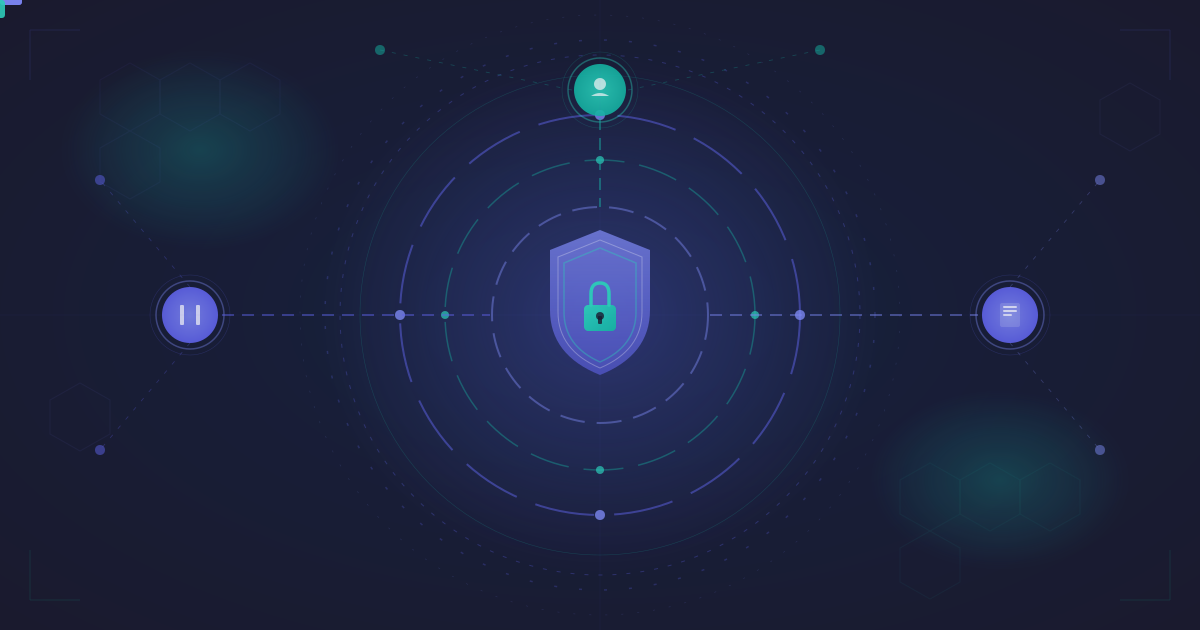
The traditional castle-and-moat security model, where everything inside the network perimeter is trusted, no longer suffices in today’s distributed, cloud-first world. Zero Trust Architecture (ZTA) represents a paradigm shift: never trust, always verify. Every access request is authenticated, authorized, and encrypted, regardless of where it originates.
This guide explores how to implement Zero Trust security architecture in enterprise environments, covering the core principles, implementation strategies, and real-world patterns.
Understanding Zero Trust Principles
The Core Tenets
Zero Trust is built on several fundamental principles:
- Verify Explicitly: Always authenticate and authorize based on all available data points
- Least Privilege Access: Limit user access with just-in-time and just-enough-access principles
- Assume Breach: Minimize blast radius and segment access. Verify end-to-end encryption
The Five Pillars of Zero Trust
Identity: Users, devices, and services must be strongly authenticated and verified.
Devices: All endpoints must be monitored and validated for security posture.
Network: Implement micro-segmentation and real-time threat protection.
Applications: Secure all applications and APIs with granular access controls.
Data: Classify, label, and encrypt data, controlling access based on sensitivity.
Identity-Centric Security
Strong Authentication
Multi-factor authentication (MFA) is mandatory in Zero Trust architectures.
// Implement adaptive MFA based on risk scoring
async function evaluateAuthenticationRisk(context) {
  const riskScore = calculateRiskScore({
    location: context.location,
    device: context.device,
    behavior: context.behaviorProfile,
    time: context.timestamp,
    network: context.networkInfo,
  });

  // Risk-based MFA requirements
  if (riskScore > 80) {
    return {
      required: ['password', 'biometric', 'hardware_key'],
      continousVerification: true,
    };
  } else if (riskScore > 50) {
    return {
      required: ['password', 'totp'],
      sessionDuration: 4 * 60 * 60, // 4 hours
    };
  } else {
    return {
      required: ['password', 'totp'],
      sessionDuration: 8 * 60 * 60, // 8 hours
    };
  }
}

function calculateRiskScore(factors) {
  let score = 0;

  // Unknown location
  if (!factors.location.isKnown) score += 30;

  // New device
  if (!factors.device.isRegistered) score += 25;

  // Unusual behavior pattern
  if (factors.behavior.anomalyScore > 0.7) score += 20;

  // Outside business hours
  const hour = new Date(factors.time).getHours();
  if (hour < 6 || hour > 20) score += 15;

  // Suspicious network
  if (factors.network.vpnDetected || factors.network.proxyDetected) {
    score += 10;
  }

  return Math.min(score, 100);
}
Continuous Verification
Authentication is not a one-time event. Continuously verify user and device posture.
class ContinuousVerificationService {
  constructor(config) {
    this.config = config;
    this.verificationInterval = 5 * 60 * 1000; // 5 minutes
  }

  async startVerification(session) {
    const intervalId = setInterval(async () => {
      try {
        const isValid = await this.verifySession(session);

        if (!isValid) {
          await this.terminateSession(session);
          clearInterval(intervalId);
        }
      } catch (error) {
        console.error('Verification failed:', error);
        await this.terminateSession(session);
        clearInterval(intervalId);
      }
    }, this.verificationInterval);

    return intervalId;
  }

  async verifySession(session) {
    // Check device posture
    const devicePosture = await this.checkDevicePosture(session.deviceId);
    if (!devicePosture.compliant) {
      return false;
    }

    // Verify token validity
    const tokenValid = await this.validateToken(session.token);
    if (!tokenValid) {
      return false;
    }

    // Check for suspicious activity
    const behaviorNormal = await this.analyzeBehavior(session.userId);
    if (!behaviorNormal) {
      return false;
    }

    // Update session activity
    await this.updateSessionActivity(session.id);

    return true;
  }

  async checkDevicePosture(deviceId) {
    const device = await this.getDeviceInfo(deviceId);

    return {
      compliant: device.osUpToDate &&
                 device.antivirusActive &&
                 device.diskEncrypted &&
                 !device.jailbroken,
      issues: this.identifyIssues(device),
    };
  }
}
Network Micro-Segmentation
Software-Defined Perimeters
Implement network segmentation that moves with your users and applications.
# Example: Kubernetes NetworkPolicy for micro-segmentation
apiVersion: networking.k8s.io/v1
kind: NetworkPolicy
metadata:
  name: api-gateway-policy
  namespace: production
spec:
  podSelector:
    matchLabels:
      app: api-gateway
  policyTypes:
  - Ingress
  - Egress
  ingress:
  # Only allow traffic from authenticated users via load balancer
  - from:
    - podSelector:
        matchLabels:
          role: load-balancer
    ports:
    - protocol: TCP
      port: 8080
  egress:
  # Allow DNS
  - to:
    - namespaceSelector:
        matchLabels:
          name: kube-system
    ports:
    - protocol: UDP
      port: 53
  # Allow access to backend services
  - to:
    - podSelector:
        matchLabels:
          tier: backend
    ports:
    - protocol: TCP
      port: 8080
  # Deny all other egress
Service Mesh Integration
Use service mesh for identity-aware service-to-service communication.
# Istio AuthorizationPolicy for Zero Trust service mesh
apiVersion: security.istio.io/v1beta1
kind: AuthorizationPolicy
metadata:
  name: user-service-authz
  namespace: production
spec:
  selector:
    matchLabels:
      app: user-service
  action: ALLOW
  rules:
  # Allow authenticated requests from API gateway
  - from:
    - source:
        principals: ["cluster.local/ns/production/sa/api-gateway"]
    to:
    - operation:
        methods: ["GET", "POST"]
        paths: ["/api/v1/users/*"]
    when:
    - key: request.auth.claims[scope]
      values: ["user.read", "user.write"]
---
apiVersion: security.istio.io/v1beta1
kind: PeerAuthentication
metadata:
  name: default
  namespace: production
spec:
  mtls:
    mode: STRICT
Device Trust and Posture Management
Device Registration and Attestation
Maintain an inventory of trusted devices with continuous posture assessment.
class DeviceTrustManager {
  async registerDevice(device) {
    // Collect device attributes
    const deviceInfo = {
      id: device.id,
      type: device.type,
      os: device.os,
      osVersion: device.osVersion,
      manufacturer: device.manufacturer,
      model: device.model,
      serialNumber: device.serialNumber,
      enrollmentDate: new Date(),
    };

    // Perform device attestation
    const attestation = await this.attestDevice(device);
    if (!attestation.valid) {
      throw new Error('Device attestation failed');
    }

    // Install device certificate
    const certificate = await this.issueDeviceCertificate(deviceInfo);

    // Register in device inventory
    await this.deviceInventory.register({
      ...deviceInfo,
      attestation,
      certificate,
      status: 'active',
    });

    return certificate;
  }

  async assessDevicePosture(deviceId) {
    const device = await this.deviceInventory.get(deviceId);
    const requirements = await this.getPostureRequirements(device.type);

    const assessment = {
      deviceId,
      timestamp: new Date(),
      checks: {},
      compliant: true,
    };

    // OS version check
    assessment.checks.osVersion = {
      required: requirements.minOsVersion,
      actual: device.osVersion,
      compliant: this.compareVersions(device.osVersion, requirements.minOsVersion) >= 0,
    };

    // Encryption check
    assessment.checks.encryption = {
      required: requirements.diskEncryption,
      actual: device.diskEncrypted,
      compliant: device.diskEncrypted === requirements.diskEncryption,
    };

    // Security software check
    assessment.checks.antivirus = {
      required: requirements.antivirusRequired,
      actual: device.antivirusActive,
      compliant: !requirements.antivirusRequired || device.antivirusActive,
    };

    // Jailbreak/root check
    assessment.checks.integrity = {
      required: requirements.noJailbreak,
      actual: !device.jailbroken,
      compliant: !device.jailbroken,
    };

    // Calculate overall compliance
    assessment.compliant = Object.values(assessment.checks)
      .every(check => check.compliant);

    await this.storeAssessment(assessment);
    return assessment;
  }

  async enforcePosture(deviceId, assessment) {
    if (!assessment.compliant) {
      // Revoke access for non-compliant devices
      await this.revokeDeviceAccess(deviceId);

      // Notify user
      await this.notifyUser(deviceId, {
        type: 'compliance_violation',
        issues: Object.entries(assessment.checks)
          .filter(([_, check]) => !check.compliant)
          .map(([name, check]) => ({
            name,
            required: check.required,
            actual: check.actual,
          })),
        remediation: 'Please update your device to meet security requirements',
      });
    }
  }
}
Application and API Security
API Gateway with Zero Trust
Every API request must be authenticated and authorized.
// API Gateway with comprehensive Zero Trust checks
class ZeroTrustAPIGateway {
  async handleRequest(req, res) {
    try {
      // 1. Extract and validate JWT token
      const token = this.extractToken(req);
      const user = await this.validateToken(token);

      // 2. Check device posture
      const deviceId = req.headers['x-device-id'];
      const devicePosture = await this.deviceTrustManager.assessDevicePosture(deviceId);

      if (!devicePosture.compliant) {
        return res.status(403).json({
          error: 'Device does not meet security requirements',
          details: devicePosture.checks,
        });
      }

      // 3. Evaluate risk score
      const riskScore = await this.evaluateRequestRisk({
        user,
        device: deviceId,
        ip: req.ip,
        resource: req.path,
        method: req.method,
      });

      // 4. Check authorization policies
      const authorized = await this.checkAuthorization({
        user: user.id,
        resource: req.path,
        action: req.method,
        context: {
          riskScore,
          devicePosture,
          location: req.headers['x-forwarded-for'],
        },
      });

      if (!authorized) {
        await this.logSecurityEvent({
          type: 'authorization_denied',
          user: user.id,
          resource: req.path,
          reason: 'insufficient_permissions',
        });
        return res.status(403).json({ error: 'Access denied' });
      }

      // 5. Apply rate limiting
      const rateLimit = await this.checkRateLimit(user.id, req.path);
      if (!rateLimit.allowed) {
        return res.status(429).json({
          error: 'Rate limit exceeded',
          retryAfter: rateLimit.retryAfter,
        });
      }

      // 6. Add security headers to request
      req.securityContext = {
        userId: user.id,
        deviceId,
        riskScore,
        permissions: user.permissions,
      };

      // 7. Forward to backend service
      const response = await this.proxyRequest(req);

      // 8. Log successful access
      await this.logAccess({
        user: user.id,
        resource: req.path,
        method: req.method,
        statusCode: response.status,
        riskScore,
      });

      return response;
    } catch (error) {
      await this.logSecurityEvent({
        type: 'gateway_error',
        error: error.message,
        request: {
          path: req.path,
          method: req.method,
        },
      });
      return res.status(500).json({ error: 'Internal server error' });
    }
  }

  async evaluateRequestRisk(context) {
    let score = 0;

    // High-risk resources
    if (context.resource.includes('/admin') ||
        context.resource.includes('/delete')) {
      score += 20;
    }

    // Device risk
    if (context.device.riskScore > 50) {
      score += 30;
    }

    // Geographic anomaly
    const normalLocation = await this.getUserNormalLocation(context.user);
    if (this.calculateDistance(normalLocation, context.ip) > 1000) {
      score += 25;
    }

    // Time-based risk
    const hour = new Date().getHours();
    if (hour < 6 || hour > 22) {
      score += 15;
    }

    return Math.min(score, 100);
  }
}
Data Classification and Protection
Automatic Data Classification
Classify data based on sensitivity and apply appropriate controls.
class DataClassificationService {
  constructor() {
    this.patterns = {
      pii: [
        /\b\d{3}-\d{2}-\d{4}\b/, // SSN
        /\b[A-Z0-9._%+-]+@[A-Z0-9.-]+\.[A-Z]{2,}\b/i, // Email
        /\b\d{16}\b/, // Credit card
      ],
      phi: [
        /\bpatient\s+id\b/i,
        /\bmedical\s+record\b/i,
        /\bdiagnosis\b/i,
      ],
      financial: [
        /\baccount\s+number\b/i,
        /\brouting\s+number\b/i,
        /\biban\b/i,
      ],
    };
  }

  async classifyData(data) {
    const classifications = new Set();

    for (const [category, patterns] of Object.entries(this.patterns)) {
      for (const pattern of patterns) {
        if (pattern.test(JSON.stringify(data))) {
          classifications.add(category);
        }
      }
    }

    // Determine highest classification level
    if (classifications.has('phi')) return 'highly_confidential';
    if (classifications.has('pii') || classifications.has('financial')) {
      return 'confidential';
    }
    return 'internal';
  }

  async applyDataProtection(data, classification) {
    const protections = {
      highly_confidential: {
        encryption: 'AES-256',
        access: 'explicit_grant_only',
        audit: 'all_access',
        retention: 90,
      },
      confidential: {
        encryption: 'AES-256',
        access: 'role_based',
        audit: 'modification_only',
        retention: 365,
      },
      internal: {
        encryption: 'AES-128',
        access: 'authenticated_users',
        audit: 'none',
        retention: 730,
      },
    };

    const policy = protections[classification];

    // Apply encryption
    const encryptedData = await this.encrypt(data, policy.encryption);

    // Set access controls
    await this.setAccessPolicy(encryptedData.id, policy.access);

    // Configure audit logging
    await this.configureAudit(encryptedData.id, policy.audit);

    // Set retention policy
    await this.setRetention(encryptedData.id, policy.retention);

    return {
      data: encryptedData,
      classification,
      policy,
    };
  }
}
Monitoring and Analytics
Security Information and Event Management (SIEM)
Centralize security events and detect anomalies.
class ZeroTrustSIEM {
  async collectSecurityEvents() {
    const sources = [
      'authentication_service',
      'api_gateway',
      'device_management',
      'network_firewall',
      'application_logs',
    ];

    const events = await Promise.all(
      sources.map(source => this.fetchEvents(source))
    );

    return events.flat();
  }

  async detectAnomalies(events) {
    const anomalies = [];

    // Detect impossible travel
    const travelAnomalies = await this.detectImpossibleTravel(events);
    anomalies.push(...travelAnomalies);

    // Detect unusual access patterns
    const accessAnomalies = await this.detectUnusualAccess(events);
    anomalies.push(...accessAnomalies);

    // Detect brute force attempts
    const bruteForceAnomalies = await this.detectBruteForce(events);
    anomalies.push(...bruteForceAnomalies);

    // Detect privilege escalation
    const escalationAnomalies = await this.detectPrivilegeEscalation(events);
    anomalies.push(...escalationAnomalies);

    return anomalies;
  }

  async detectImpossibleTravel(events) {
    const anomalies = [];
    const loginEvents = events.filter(e => e.type === 'login_success');

    // Group by user
    const userLogins = this.groupBy(loginEvents, 'userId');

    for (const [userId, logins] of Object.entries(userLogins)) {
      const sorted = logins.sort((a, b) => a.timestamp - b.timestamp);

      for (let i = 1; i < sorted.length; i++) {
        const prev = sorted[i - 1];
        const curr = sorted[i];

        const distance = this.calculateDistance(
          prev.location,
          curr.location
        );
        const timeDiff = (curr.timestamp - prev.timestamp) / 1000 / 60 / 60; // hours
        const speed = distance / timeDiff; // km/h

        // Impossible to travel this fast
        if (speed > 1000) {
          anomalies.push({
            type: 'impossible_travel',
            userId,
            severity: 'high',
            events: [prev, curr],
            details: {
              distance,
              timeDiff,
              speed,
            },
          });
        }
      }
    }

    return anomalies;
  }

  async respondToAnomaly(anomaly) {
    switch (anomaly.severity) {
      case 'critical':
        await this.lockAccount(anomaly.userId);
        await this.notifySecurityTeam(anomaly);
        break;
      case 'high':
        await this.requireReauthentication(anomaly.userId);
        await this.notifySecurityTeam(anomaly);
        break;
      case 'medium':
        await this.flagForReview(anomaly);
        break;
      default:
        await this.logAnomaly(anomaly);
    }
  }
}
Implementation Roadmap
Phase 1: Foundation (Weeks 1-4)
- Identity Infrastructure: Implement strong authentication with MFA
- Device Management: Deploy device registration and posture assessment
- Network Segmentation: Begin micro-segmentation of critical systems
Phase 2: Enforcement (Weeks 5-8)
- API Security: Deploy Zero Trust API gateway
- Access Policies: Implement fine-grained authorization
- Data Classification: Begin automatic data classification
Phase 3: Monitoring (Weeks 9-12)
- SIEM Integration: Centralize security event collection
- Anomaly Detection: Deploy behavioral analytics
- Incident Response: Establish automated response procedures
Phase 4: Optimization (Ongoing)
- Continuous Improvement: Refine policies based on analytics
- User Experience: Optimize for security without friction
- Compliance: Maintain alignment with regulatory requirements
Common Challenges and Solutions
Challenge: User Experience Impact
Solution: Implement adaptive authentication that adjusts requirements based on risk.
Challenge: Legacy Applications
Solution: Use reverse proxies to add Zero Trust capabilities to applications that cannot be modified.
Challenge: Device Diversity
Solution: Implement different posture requirements for managed vs. BYOD devices.
Challenge: Performance Overhead
Solution: Cache authentication decisions and use efficient token validation.
Conclusion
Zero Trust Architecture represents the future of enterprise security. By assuming breach, verifying explicitly, and enforcing least privilege access, organizations can significantly reduce their attack surface and improve their security posture.
Key takeaways:
- Identity is the new perimeter
- Continuous verification is essential
- Micro-segmentation limits blast radius
- Device posture matters
- Data classification drives protection
- Monitoring and analytics enable detection and response
Implementing Zero Trust is a journey, not a destination. Start with the foundation, build incrementally, and continuously refine your approach based on real-world results and emerging threats.