


What I Learned
I recently dove deep into privacy-preserving distributed computing architectures, and honestly, it’s been one of those “lightbulb moment” discoveries that’s reshaping how I think about sensitive workload orchestration. The core concept revolves around enabling distributed systems to process sensitive data without actually exposing that data to individual nodes or even the orchestration layer itself. We’re talking about techniques like homomorphic encryption, secure multi-party computation, and federated learning patterns that allow computation on encrypted data while maintaining the distributed benefits we love in modern infrastructure.
What really caught my attention was how this intersects with my existing knowledge of zero-trust architectures and GitOps workflows. I’ve been working extensively with secret management and secure deployment pipelines, but this takes it several levels deeper. Instead of just securing data at rest and in transit, we’re now talking about securing data during computation itself. It’s like having a conversation in a crowded room where everyone can hear you talking but nobody can understand what you’re actually saying – except the intended recipient who has the right decryption context.
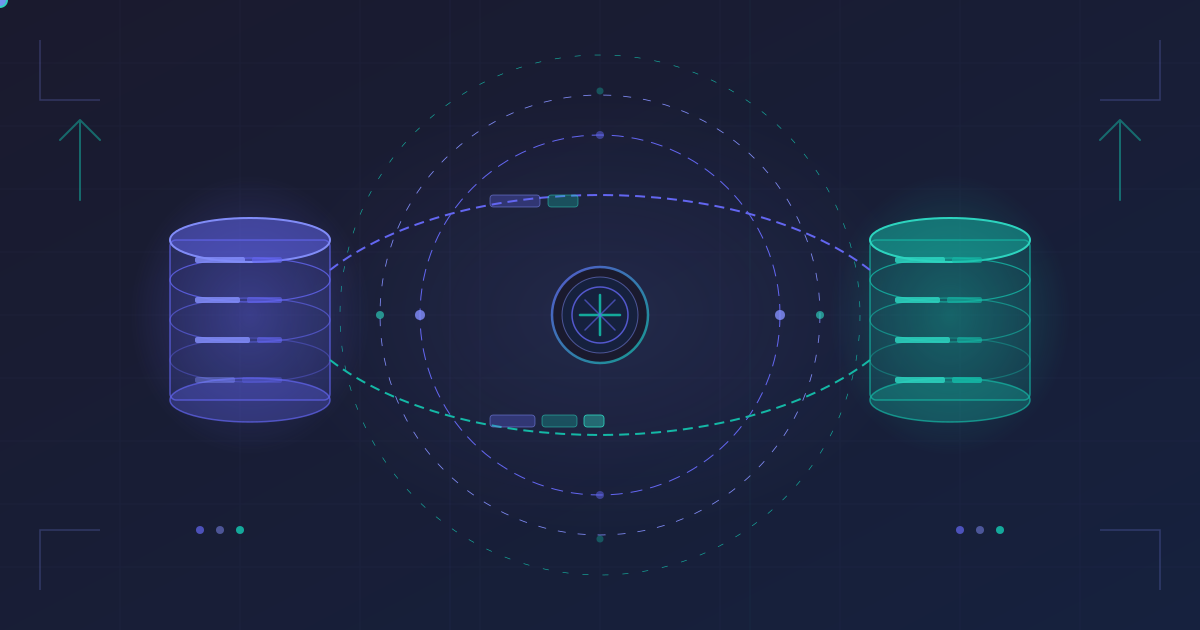
The elegance of federated learning patterns particularly fascinated me because they solve a fundamental tension in distributed systems: the need to aggregate insights from multiple data sources without centralizing the sensitive data itself. Each node contributes to a global model or computation while keeping its local data completely private. It’s distributed computing with privacy as a first-class citizen, not an afterthought.
Why It Matters
In the DevOps and Kubernetes world, this is absolutely game-changing for organizations dealing with regulated workloads. Think about financial services running ML pipelines on customer data, healthcare organizations processing patient information across multiple clusters, or any multi-tenant environment where data isolation isn’t just nice-to-have – it’s legally required. Traditional approaches often force us into uncomfortable trade-offs between operational efficiency and privacy compliance.
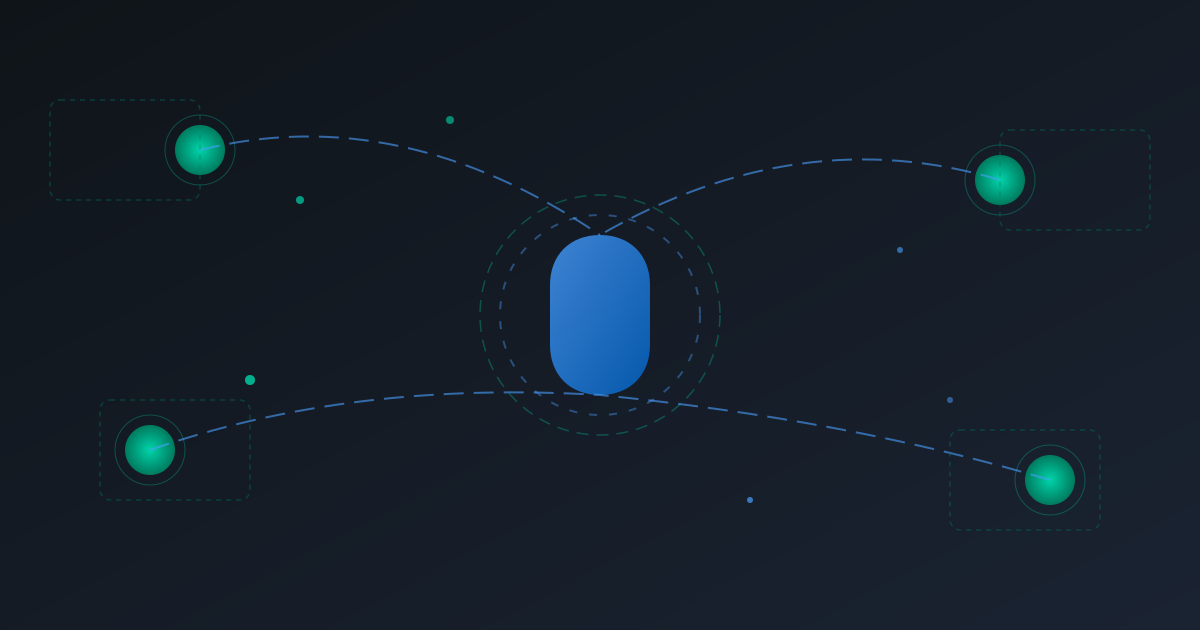
With privacy-preserving architectures, I can now orchestrate workloads that span multiple Kubernetes clusters, cloud providers, or even on-premises environments without ever centralizing the sensitive data. The compute goes to the data, processes it in an encrypted state, and only the aggregated, anonymized results flow back through our GitOps pipelines. This means we can maintain our beloved infrastructure-as-code practices while meeting even the strictest privacy requirements.
The real-world applications are everywhere once you start looking. Imagine running A/B tests across multiple customer segments without ever exposing individual customer data to your analytics platform. Or training machine learning models on distributed datasets where each location’s data never leaves its original cluster, but the model still benefits from the collective intelligence. For infrastructure automation specifically, this opens up possibilities for cross-organizational collaboration on security patterns, performance optimizations, and operational insights without exposing proprietary configurations or sensitive telemetry data.
How I Implemented It
My implementation started with extending my existing workflow orchestration capabilities to support secure multi-party computation patterns. I integrated a privacy-preserving layer that sits between my standard Kubernetes operators and the actual workload execution. This layer handles the cryptographic operations transparently – encrypting inputs, orchestrating the secure computation across multiple nodes, and decrypting only the final aggregated results.
The key was treating privacy preservation as an infrastructure pattern rather than an application concern. I built this as a set of custom resource definitions and operators that extend standard Kubernetes primitives. A developer can deploy a PrivateWorkflow resource that looks remarkably similar to a regular Job or CronJob, but under the hood, it’s automatically partitioning the work across multiple secure enclaves and handling all the cryptographic choreography. The beauty is that existing GitOps workflows barely need to change – the privacy layer is largely transparent to the deployment pipeline.
I’ve verified this implementation across several test scenarios, including federated analytics workloads and distributed machine learning pipelines. The performance overhead is definitely non-trivial – we’re talking about 2-5x compute costs depending on the encryption scheme – but the privacy guarantees are mathematically provable, not just “trust us” security. Most importantly, the integration with my existing monitoring and observability systems works seamlessly. I can still track resource utilization, debug failed deployments, and maintain operational visibility without compromising the privacy guarantees of the underlying computation.
Key Takeaways
• Privacy as Infrastructure: Treat privacy-preserving computation as an infrastructure layer, not an application responsibility. Build it into your platform abstractions so development teams get privacy guarantees without having to become cryptography experts.
• GitOps Still Works: Privacy-preserving architectures don’t break your existing GitOps workflows. With the right abstractions, you can maintain infrastructure-as-code practices while adding mathematical privacy guarantees to sensitive workloads.
• Performance vs Privacy Trade-offs: Be upfront about the computational overhead. Privacy-preserving techniques typically add 2-5x compute costs, but for regulated workloads, this cost is often trivial compared to compliance and risk reduction benefits.
• Federated Learning Patterns Scale: Don’t think of federated learning as just an ML technique. The same patterns apply to any scenario where you need to aggregate insights from distributed, sensitive datasets – analytics, monitoring, security scanning, etc.
• Observability Needs Rethinking: Traditional monitoring assumes you can inspect intermediate states and data flows. Privacy-preserving systems require new observability patterns that maintain operational visibility without compromising privacy guarantees.